Mind-controlling fungus could cause more crop damage in warmer climates - The Natural History Museum
Dead heat
For the new study, aphids and ladybirds were separated into separate groups, with one group remaining healthy while the others were infected with either a small or large amount of Beauveria bassiana spores. The researchers then tested the temperature at which the insects were unable to flip themselves over as a measure of their heat tolerance.
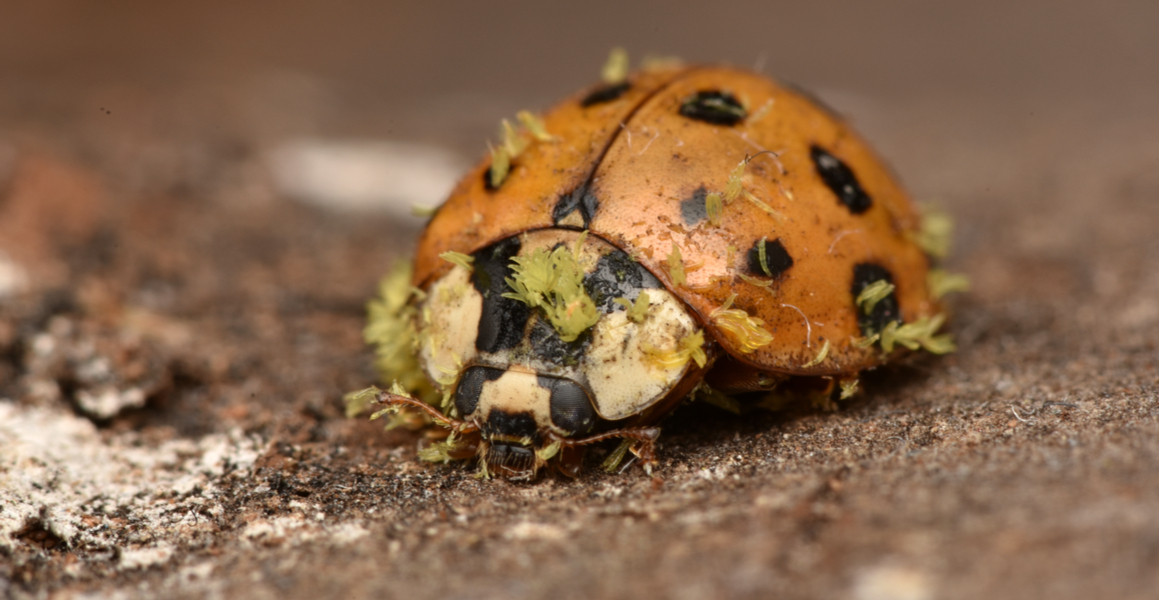
Dr Mitzy Porras, the lead author of the study, says, 'We found that the heat tolerance of fungus-infected aphids and beetles was reduced by 6.7⁰C and 4.5⁰C respectively while cold tolerance was only reduced in the beetles.
'In addition, survival was significantly reduced for infected aphids and beetles when they were exposed to both warm and cold extreme temperatures.'
The researchers suggest that the fungus is blocking a process known as behavioural fevering to help with its own survival. Behavioural fevering is when infected insects move into warmer temperatures to weaken the disease affecting them and boost their immune system.
It is thought that the fungus is taking control of the beetles to stop them from doing this. There is also some evidence that the fungus can prevent insects from controlling their own body temperature more generally so that conditions can be kept optimal.
The scientists also tested if the insects would cross areas of extreme heat or cold to reach food held in containers on the other side. While 65% of healthy aphids and ladybirds would make the journey, a similar amount of heavily infected insects wouldn't make the crossing.
This may be due to the increased energy needed to fight an infection. Even a short trip across an extremely hot or cold area requires a lot of energy to withstand, and the scientists think the insect could be conserving its energy to tackle the fungus instead.
In the long run, this might have a knock-on effect on the survival of crops across the world.
Aphids are normally kept in check by ladybirds, but if these beetles are infected with the fungus and thus reluctant to cross hot or cold areas, greater variations in temperature due to climate change could prevent them from reaching their prey. This could mean aphids become even more of a pest.
Professor Jesper Sørensen, another co-author of the paper, says, 'We have learned that the relationships between pathogens and hosts are far more complex than we once thought.
'This study focuses on a specific case but has broad implications for the way we see these interactions which can now be seen as another important dimension of ecology.'
Comments
Post a Comment